It’s 11:00 PM on a Tuesday. A CTO at an EV startup in Bengaluru or a Defense-tech lab in Hyderabad is staring at an empty inbox. They’ve spent six months perfecting a complex Battery Management System (BMS) or a ruggedized flight controller. The design is revolutionary. The initial order? 2,000 units.
The response from the “Mega-Factories” of the world? Silence. Or worse, a quote so bloated with “setup fees” and “minimum order quantities” (MOQs) that it effectively functions as a polite “go away.”
This is the dirty secret of India’s electronics boom. While headlines celebrate the “Millions of Units” produced by giants like Foxconn or Dixon, a massive rift has opened in the ecosystem. We are building a manufacturing landscape designed for oil tankers—massive, powerful, and capable of moving in exactly one direction—while our deep-tech innovators are piloting speedboats that need to pivot on a dime.
If you are building the future of Indian hardware, you don’t need a mega-factory. You need an HMLV specialist. You need a partner that speaks the language of high-complexity, not just high-volume.
The Scale Paradox: When “Bigger” Means “Slower”
India’s current policy push, from PLI 2.0 to the various semiconductor missions, is obsessed with scale. And for consumer electronics—smartphones, chargers, basic wearables—scale is the only metric that matters. But for deep-tech, scale is a paradox.
Deep-tech hardware—think motor controllers for high-performance EVs, satellite sub-systems, or AI-enabled surveillance—is inherently “High-Mix, Medium-Volume” (HMLV). These products require constant iteration. You might need five versions of a PCBA before the first 5,000 units ever hit the market.
To a mega-factory, a design change is an enemy. Their business model relies on keeping a line running the same board for six months straight. When a startup asks for a design tweak after the first 500 units, they aren’t just asking for a technical change; they are disrupting a multi-billion-rupee machine optimized for inertia. In the world of mass production, innovation is a bottleneck.
The Agility Gap: Solving the “Changeover” Math
At the heart of this failure is a simple engineering metric: Changeover Time.
In a traditional mega-factory, resetting an SMT (Surface Mount Technology) line for a new product can take a full shift—sometimes longer. If that line is intended to run for 30 days straight, a 12-hour setup is a rounding error. But if your total production run only lasts 48 hours, that setup time makes the project economically impossible.
This is where Chipmates draws a line in the sand.
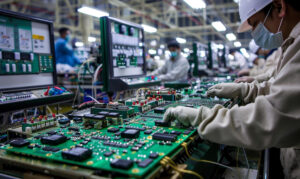
Located in the heart of the Redhills/Sriperumbudur corridor, our facility was engineered as a Greenfield site specifically to bridge this agility gap. We operate four high-speed, high-precision SMT lines designed for rapid deployment. Our engineering teams are measured on how quickly they can move from NPI (New Product Introduction) to stable production, not just how many millions of components they can “pop” in a day.
When we talk about 01005 component placement or complex multi-layer boards, we aren’t just boasting about our machinery. We are talking about the ability to handle the extreme miniaturization required by IIoT and Defense sectors without sacrificing the speed of iteration.
Reliability is Not a Checkbox
There is a fundamental difference between a smartphone and a Defense-grade flight computer. If a smartphone board fails, a customer is annoyed. If a BMS fails in an EV at 80km/h, or a motor controller fails in a tactical drone, the consequences are catastrophic.
The mega-factories chasing consumer margins often treat quality as a “Pass/Fail” checkbox at the end of the line. For deep-tech, reliability must be baked into the DfM (Design for Manufacturing) phase.
At Chipmates, we operate under IPC Class 3 standards—the highest tier of electronics manufacturing reliability. This involves rigorous AOI (Automated Optical Inspection) and X-Ray inspection to ensure that hidden solder joints under BGA components are flawless. In the Defense and Medical sectors, “close enough” is a death sentence. We provide the “Special Ops” level of manufacturing where every board is treated as mission-critical hardware, not a commodity.
The “Joint-ODM” Perspective: We’ve Been in Your Shoes
Most EMS providers are purely “Build-to-Print.” You give them a file; they give you a board. If the board doesn’t work, they blame your design.
We find that approach lazy.
Chipmates is evolving into a Joint-ODM. We develop our own proprietary, AI-enabled CCTV and DVR hardware. This means when we look at your BOM (Bill of Materials), we aren’t just looking at part numbers. We are looking for “Flash Shortages,” thermal risks, and component end-of-life issues. We’ve felt the pain of a “design-to-deploy” cycle ourselves.
When you partner with us, you aren’t just renting line time; you are accessing a collective intelligence that understands how to optimize a PCBA for the harsh electrical and thermal environments of India.
Why the Chennai Corridor is the New Silicon Valley
Geography matters. The Redhills/Sriperumbudur corridor isn’t just a manufacturing hub; it’s an ecosystem. By being positioned here, Chipmates offers deep-tech startups something a distant “mega-site” cannot: Engineering Proximity.
During the NPI phase, your engineers need to be on the floor. They need to see the first boards coming off the reflow oven. They need to sit with our DfM experts to shave 10% off the assembly cost by repositioning a single connector. This “physical feedback loop” is what accelerates runways and wins markets.
Stop Begging for Line Time
The era of the “Mega-Factory” as the only path to hardware success is over. If you are building high-complexity hardware that requires IPC Class 3 reliability and HMLV agility, stop waiting for the giants to notice you.
You deserve a partner that views your 2,000-unit “innovation” with the same gravity as a 2-million-unit commodity. You need a facility that was built from the ground up to be the “brain” of Indian manufacturing, not just the hands.
The future of Indian hardware isn’t being built on the massive, inflexible lines of yesterday. It’s being built, component by precision component, at Chipmates.
Let’s build the future. One high-precision board at a time.