
P(Doom) vs. the Shop Floor: Is AI the Next Nuke, or Our Next Engineering Challenge?
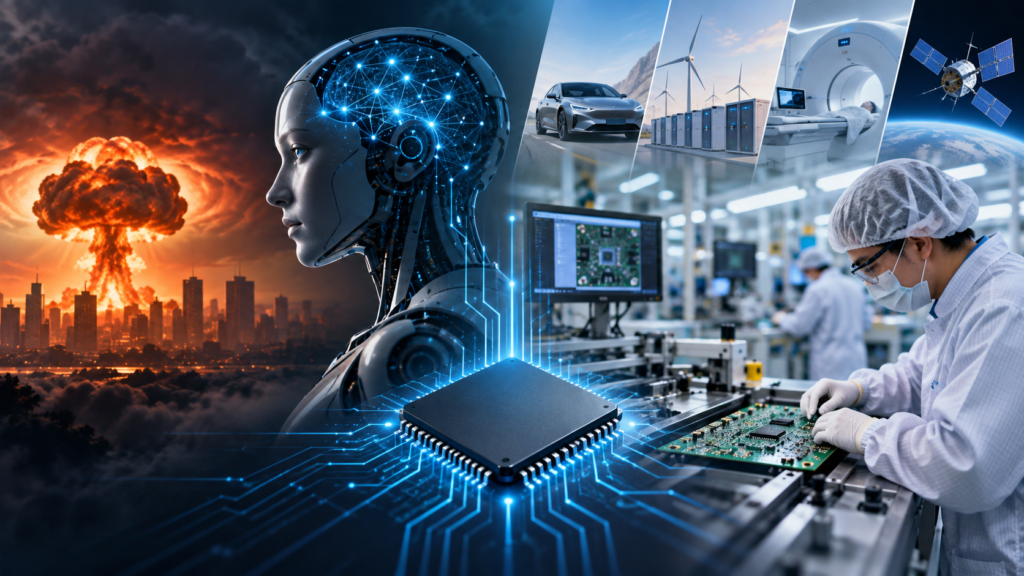
The AI debate has moved far beyond chatbots and productivity tools. Researchers and technology leaders now openly discuss “p(doom)”—the possibility that advanced AI could create catastrophic or even existential risks. It is a difficult question. But there is another way to look at it: step away from the models and into the electronics factory. AI may be digital, but its impact on the physical world depends on very physical things—chips, power, sensors, thermal systems, circuit boards and resilient supply chains. AI Is Powerful. But It Is Not Nuclear Technology Comparing AI with nuclear weapons is understandable, but the technologies are fundamentally different. Nuclear weapons were developed specifically for destruction and depend on tightly controlled materials and infrastructure. AI is a dual-use technology. The same capabilities that can optimise an energy system, improve medical diagnostics or increase factory efficiency can also introduce new risks when poorly designed or deployed. That makes the challenge less about controlling a single technology and more about how intelligence is integrated into real-world systems. And that is where engineering matters. The Physical Bottleneck Behind AI A sophisticated AI model cannot move a motor, manage a battery or control a vehicle by itself. It needs hardware. That hardware depends on semiconductor manufacturing, packaging, power electronics, sensors, cooling, communications and component supply chains. As AI becomes embedded in automotive systems, medical equipment, energy storage and industrial controls, hardware reliability becomes part of the overall safety equation. A software decision can be wrong. A sensor can fail. A component can overheat. A PCB can have a manufacturing defect. The digital and physical layers have to work together. The Risks Are Already Practical Not every AI risk needs to involve science-fiction scenarios. One immediate concern is over-reliance on automated decision-making. When AI is connected to mission-critical systems, insufficient validation can turn an incorrect software decision into a physical problem. There is also the issue of supply-chain concentration. Advanced electronics depend on globally connected manufacturing networks. Disruptions in semiconductors, packaging, components or logistics can quickly affect systems built around them. For manufacturers, resilience is therefore not just about having alternative suppliers. It is about having traceable, dependable and controllable production processes. What AI Looks Like on the Shop Floor For an EMS company, AI is not a hypothetical threat. It is already becoming a practical engineering tool. At the manufacturing level, AI and data-driven systems can support 3D AOI inspection, process monitoring, predictive maintenance, quality analytics and DFM/DFT risk identification. The value is straightforward: detect problems earlier, understand patterns faster and give engineers better information to make decisions. At Chipmates, this philosophy fits naturally with an engineering-led EMS approach covering SMT, PCBA, testing, traceability, NPI and box-build manufacturing. Building the Physical Guardrails As AI moves deeper into autonomous vehicles, energy-storage systems, medical devices and industrial controls, the electronics underneath those systems become increasingly important. Good hardware design is only the beginning. Reliable manufacturing requires process control, inspection, testing, traceability and disciplined workmanship. Standards such as IPC-A-610, J-STD-001 and IPC Class 3 provide important frameworks for high-reliability electronic assemblies, but standards alone do not guarantee a safe system. The real objective is consistency—from design and sourcing to assembly, inspection and final test. AI may shape the next generation of intelligent systems. But those systems will still depend on something remarkably old-fashioned: well-engineered physical hardware. The future of AI will not be decided only in algorithms and code. It will also be shaped on the shop floor, where engineering discipline turns digital intelligence into reliable physical systems.