
The Missing Link in India’s Silicon Mission: Why OSAT-EMS Integration is the 2026 Gamechanger
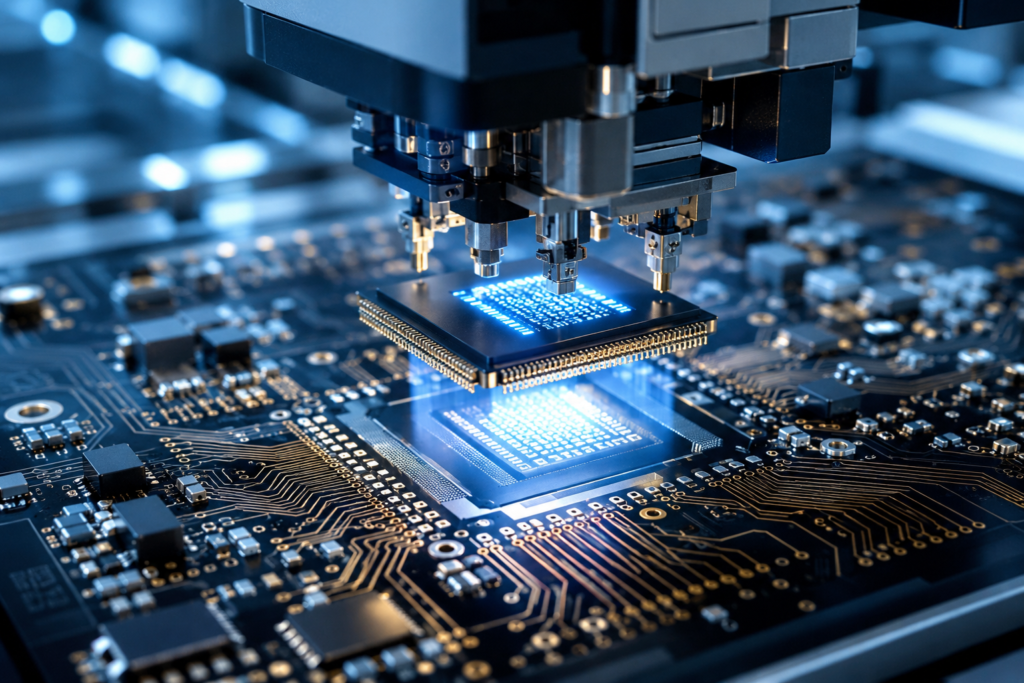
In the spring of 2026, the industrial landscape of India has reached a fever pitch. We have all seen the historic “Photo Ops”: the first silicon wafers emerging from Gujarat, and the ribbon-cutting ceremonies at massive OSAT (Outsourced Semiconductor Assembly and Test) facilities in Sanand and Telangana. For the first time, “Made in India” semiconductors are not a policy aspiration—they are a high-tech reality. But as a consultant who has spent two decades navigating the global semiconductor supply chain, I find myself asking the provocative question that most headlines ignore: What happens next? A semiconductor chip, however advanced, is a dormant component until it is integrated into a system. It is the “soul” of an electronic device, but it lacks a “body.” To find its way into a high-performance drone, a mission-critical Battery Management System (BMS), or an AI-enabled surveillance camera, that chip must be mounted onto a Printed Circuit Board (PCB) with surgical precision. This is the “Missing Link” in the India Semiconductor Mission (ISM) 2.0: the critical, often broken handoff between the OSAT provider and the Electronic Manufacturing Services (EMS) partner. Section 1: The OSAT Handoff—The New Supply Chain Friction For decades, the “handoff” was simple because it happened elsewhere—mostly in the massive integrated hubs of East Asia. In that ecosystem, the OSAT plant and the EMS factory were often in the same industrial park. In India’s emerging 2026 landscape, we are building a geographically distributed model. The transition from a finished semiconductor package to a finished electronic product is the most delicate stage of the lifecycle. If a chip is packaged with state-of-the-art precision in Gujarat but sent to an EMS provider with legacy equipment and a “low-tech” mindset, the technological advantage of the domestic silicon is instantly neutralized. The industry is currently facing an “Agility Gap.” While India has successfully attracted the silicon giants, much of the domestic EMS sector is still optimized for high-volume, low-complexity consumer goods. They are culturally and technically unequipped for the rigors of integrating the high-value, high-complexity silicon coming off India’s new assembly lines. Section 2: The “Design-to-Package” Synergy In 2026, the boundary between semiconductor packaging and board assembly is blurring. We are entering the era of Heterogeneous Integration and SiP (System-in-Package). These aren’t just buzzwords; they represent a fundamental shift where multiple silicon dies and passives are integrated into a single high-density package. This shift demands a new level of synergy. If an Indian fabless startup designs a cutting-edge AI processor, they need an OSAT partner that can package it and an EMS partner that can handle the High-Density Interconnect (HDI) requirements of the board it sits on. If the chip is packaged in Sanand but the board assembly is handled with a 1990s-era mindset, lead times explode and yields plummet. To truly defy the Red Sea disruptions and global logistics choke points, the OSAT-EMS link must be a seamless, high-tech corridor. Without this integration, the “Silicon Mission” is a bridge that stops halfway across the river. Section 3: Chipmates as the Integration Layer This is exactly why we established Chipmates as a Greenfield facility in the Redhills/Sriperumbudur corridor. We didn’t build a factory for yesterday’s electronics; we built an Integration Layer for tomorrow’s silicon. As chips get smaller and more powerful, the SMT (Surface Mount Technology) requirements become extreme. We are no longer just placing components; we are managing microscopic tolerances. Our facility is “Silicon-Ready,” featuring: We serve as the downstream partner for the new Indian silicon ecosystem, ensuring that the innovation happening at the wafer level isn’t lost during board-level integration. Section 4: The 2026 Vision—Building the “Silicon Shield” The ultimate goal of ISM 2.0 isn’t just “Assembling in India.” It is about creating an Integrated Ecosystem that is immune to global geopolitical volatility. This is what we call the “Silicon Shield.” By integrating OSAT and EMS capabilities within the Indian border, we reduce the “Time-to-Market” and the “Cost-of-Quality.” When a design house in Bengaluru can have their chip packaged in Gujarat and integrated onto a board in Chennai, the “Lead-time Volatility” that has plagued the industry for years finally vanishes. This localized value addition is where the real margin lies. It transforms India from a destination for “cheap labor” into a global hub for “elite engineering.” Conclusion: Bridging the Gap To the fabless design houses, the hardware OEMs, and the visionaries of India’s tech landscape: The chip is only the beginning. If you are betting your future on the new wave of Indian silicon, you cannot afford a “weak link” in your manufacturing chain. You need a partner that speaks the language of OSAT, understands the physics of HDI, and possesses the Greenfield agility to scale with you. At Chipmates, we are more than an EMS provider; we are the bridge between your silicon and your customer. The “Missing Link” has been found. Don’t just make a chip. Build a system. Build it with Chipmates.