
From Pure EMS to Joint-ODM: Decoupling Indian Hardware from Foreign IP Dependencies
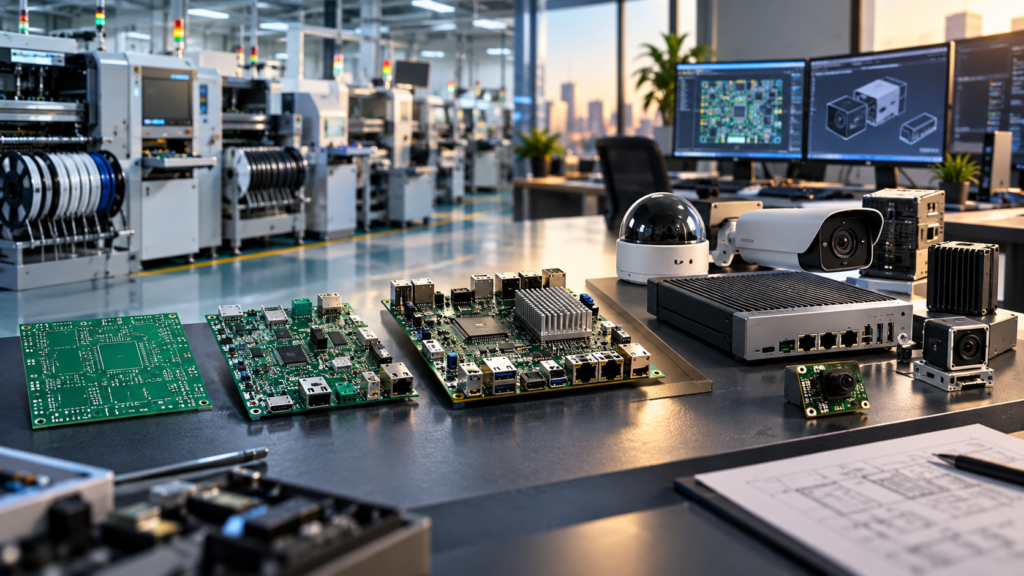
A product can be manufactured in India without the technology behind it being Indian. A PCB may be assembled locally, tested locally and shipped from an Indian factory, while its processor, reference design, firmware ecosystem and core intellectual property remain controlled elsewhere. That distinction is becoming increasingly important as India moves from electronics assembly toward deeper product and technology ownership. The Limitation of the Pure EMS Model In a traditional EMS (Electronics Manufacturing Services) relationship, the OEM owns the design and the EMS provider manufactures it. This model works well when the primary requirement is production capacity. But as products become more complex, manufacturing and engineering can no longer operate completely separately. If the manufacturer is involved only after the design is finalised, opportunities to improve architecture, manufacturability, component strategy and product scalability may be limited. The result can be a product that is successfully manufactured in India, but whose critical technology remains dependent on external platforms. This is not necessarily a weakness. Modern electronics will continue to rely on global components and technologies. The strategic question is how much of the product knowledge, architecture and IP can be developed and controlled within India. Why Joint-ODM Changes the Equation The next step is not simply moving from EMS to ODM. A Joint-ODM model creates a collaborative relationship between the OEM and manufacturing partner. Instead of: “Here is my design. Please build it.” the conversation becomes: “Let us build and evolve the product together.” The manufacturing partner can contribute to hardware architecture, DFM, product engineering, testing and production optimisation, while the OEM retains clearly defined ownership of its strategic IP. This can shorten the distance between engineering and manufacturing, reduce avoidable redesigns and create reusable hardware platforms for future products. For an Indian hardware company, that capability can be significant. The objective is not to eliminate foreign technology overnight, but to progressively reduce unnecessary dependency. Why Indian IP Matters Global technology competition, supply-chain diversification and tighter controls around strategic technologies have made technology ownership a business consideration—not just an engineering one. This matters particularly in defence, surveillance, EV and Industrial IoT. Consider an Indian company developing an intelligent surveillance product. Under a pure EMS model, the company supplies the completed design and the manufacturer builds it. Under a Joint-ODM model, the manufacturing partner can participate earlier in hardware architecture, production engineering and product-platform development. That platform may then support multiple product variants. The relationship moves from manufacturing a product to helping develop a product family. The Opportunity for Indian Electronics India does not need to build every semiconductor, component or software platform domestically to become more technologically capable. A more practical path is to increase ownership of the layers that differentiate the product: system architecture, hardware design, firmware, integration, product engineering and application-specific IP. That is where the transition from “assembled in India” toward “designed, developed and manufactured in India” becomes meaningful. It is also where a capable EMS company can evolve into a technology-development partner without competing directly with its OEM customers. The Chipmates Perspective At Chipmates, we see the future of Indian EMS extending beyond contract manufacturing. Our direction toward Joint-ODM and product co-development, including work on proprietary AI-enabled CCTV/DVR hardware, reflects a broader belief: manufacturing capability should increasingly connect with engineering and product innovation. The goal is not complete technological isolation. It is greater control over the technology that creates product differentiation and long-term value. India’s electronics journey should not stop at making more products. The bigger opportunity is to build products whose engineering, innovation and intellectual property increasingly originate in India.