
Electronics Lifecycle Engineering: Designing Beyond the First Production Run
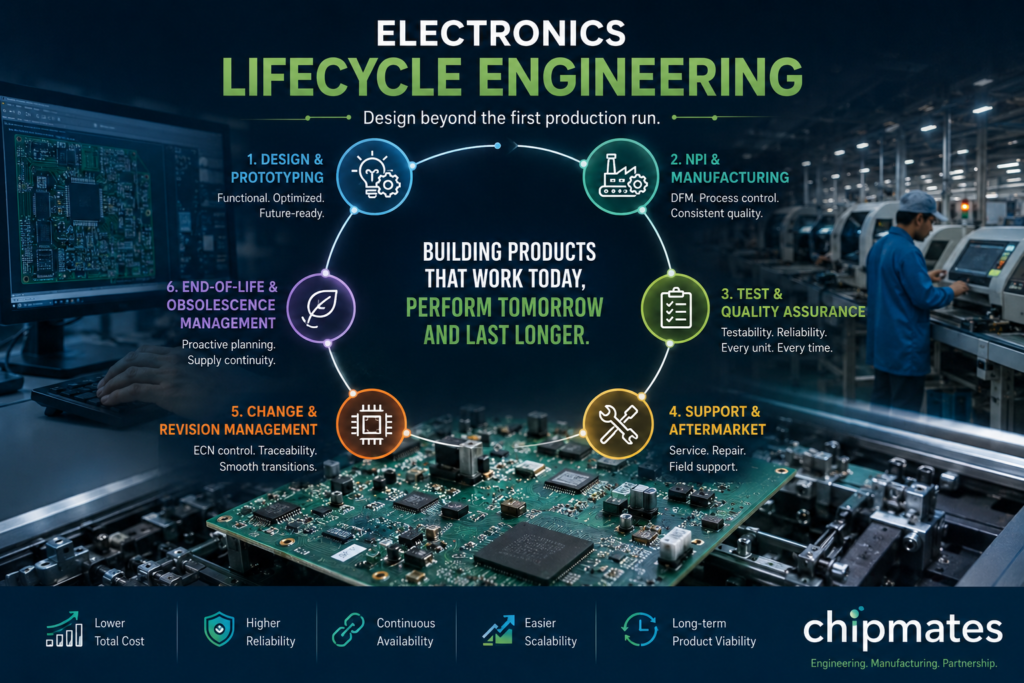
An electronics product is not finished when the prototype works. In many cases, that is when the harder questions begin. Can it be manufactured consistently? Will the components remain available? Can every unit be tested reliably? What happens when a component becomes obsolete or the product needs a revision two years later? These questions highlight the importance of Electronics Lifecycle Engineering—an approach that considers the product from initial design through manufacturing, support and eventual end-of-life. What Is Electronics Lifecycle Engineering? Electronics Lifecycle Engineering means looking at the complete journey of a product instead of treating manufacturing as the final stage. A design decision made during development can affect production cost, testability, sourcing, reliability and serviceability much later. Lifecycle engineering brings these considerations into the engineering process early, when changes are easier and less expensive to make. For OEMs and product companies, this creates a more practical connection between engineering intent and production reality. Where Lifecycle Challenges Appear The lifecycle begins with product design and prototyping. At this stage, the focus is usually on functionality and performance. But as the design moves into NPI and volume manufacturing, other factors become critical. A component that worked well in a prototype may have limited availability. A PCB may be difficult to assemble consistently at scale. Test access that was convenient during development may not be practical on a production line. Then comes change management. Component substitutions, firmware updates, PCB revisions and process changes must be controlled carefully. Without proper revision control and traceability, even a small engineering change can create production and quality issues. The lifecycle also continues after manufacturing. Repair, service, field support and component availability become increasingly important, particularly for products expected to remain in the market for several years. Eventually, component obsolescence becomes a reality. A lifecycle approach considers this early rather than waiting until a critical part disappears from the supply chain. Why Think Beyond Production? The cost of an electronics product is not determined only by its manufacturing price. Design choices influence assembly time, test requirements, component sourcing, rework, reliability and long-term service. Addressing these factors earlier can reduce avoidable engineering changes and production disruptions later. This is especially relevant for products where reliability and continuity are essential. The goal is not simply to manufacture a product successfully today, but to make sure it can continue to be manufactured and supported tomorrow. The Role of an EMS Partner A capable EMS partner can contribute much earlier than the production stage. Through Design for Manufacturing (DFM), component strategy, testability planning, process control and traceability, manufacturing considerations can become part of the product development conversation. This creates a stronger connection between design engineering, NPI and factory execution. It also gives OEMs a clearer path for managing revisions, scaling production and addressing lifecycle risks. At Chipmates, we see electronics manufacturing as part of a larger engineering lifecycle—not simply the final step after design. The real objective is straightforward: build products that are not only functional, but manufacturable, reliable, supportable and viable throughout their lifecycle. Because successful electronics engineering is not just about making a product work once. It is about making it work consistently, at scale, and for as long as the product needs to remain in the field.