A connected electronic product can be perfectly designed, securely coded and rigorously tested—and still leave the factory with a security weakness.
The reason is simple: cybersecurity is no longer only a software problem. It increasingly begins inside the manufacturing environment.
As electronics become smarter and more connected, the factory floor has become part of the product’s security architecture. For EV controllers, BMS units, Industrial IoT devices, surveillance equipment and defence electronics, a compromised manufacturing process can create risks that remain invisible until the product is already deployed.
Why the Factory Is Becoming an Attack Surface
Modern electronics manufacturing involves far more than placing components on a PCB. Components are sourced, programmed, tested, serialized, inspected and linked to production records. Firmware may be loaded during manufacturing, test stations communicate with production systems, and each finished board may carry a unique digital identity.
Every one of these steps introduces another point that must be controlled.
Consider firmware loading. If an unauthorized or outdated firmware image is introduced during production, the finished product may pass normal functional testing while carrying a hidden vulnerability.
The same applies to components. A counterfeit, recycled or compromised component may not immediately cause a visible failure. In safety-critical or connected equipment, however, its impact can extend well beyond manufacturing quality.
The Supply Chain Is Part of the Security Chain
Electronics supply chains are becoming increasingly global and complex. A PCB may contain components sourced from multiple countries, pass through several distributors and finally reach an EMS facility for assembly.
That creates a need for more than procurement discipline. Manufacturers need confidence in component authenticity, supplier traceability and controlled substitution.
For strategic electronics, knowing what was assembled is only part of the question. Manufacturers also need to know where it came from, which lot it came from, which firmware was loaded, how it was tested and who had access to the process.
This is where manufacturing traceability becomes a cybersecurity asset rather than simply a quality record.
Why This Matters for EV, Industrial IoT and Defence
For an industrial IoT device, unauthorized firmware could become a gateway into a larger operational network.
For an EV, a compromised controller or BMS can create safety, reliability and reputational risks.
For defence and surveillance electronics, the stakes are even higher. Hardware integrity, firmware authenticity and manufacturing confidentiality can have strategic consequences.
The challenge is therefore no longer simply to manufacture a board that works. It is to manufacture a board whose origin, configuration and production history can be trusted.
What Secure Electronics Manufacturing Should Look Like
Secure manufacturing does not require turning an EMS factory into a cybersecurity company. It requires security to be embedded into existing manufacturing discipline.
That means controlled firmware and programming processes, authenticated components, restricted access to production systems, reliable traceability, protected manufacturing data and clear revision control.
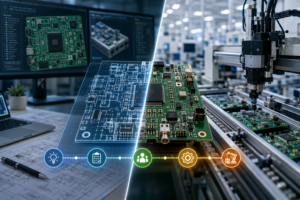
It also means connecting engineering, procurement, quality and manufacturing teams. Security gaps often emerge at the boundaries between these functions, not within a single process.
The Chipmates Perspective
At Chipmates, we believe the conversation around hardware security must move upstream.
For high-reliability electronics, secure-by-design should be complemented by secure-by-manufacturing. Traceability, controlled programming, component authenticity and production-data integrity should be considered part of the product lifecycle—not separate administrative activities.
India’s growing electronics manufacturing ecosystem creates an opportunity to build products that are not only made locally, but manufactured with stronger control over their hardware and production chain.
The factory floor is no longer just where a product is assembled.
It is one of the places where trust in that product is created—or compromised.
That is why the future of electronics manufacturing will depend not only on speed, precision and cost, but also on the ability to protect the integrity of every board that leaves the factory.